Photo strip

Photo strip

15 October 2010

Signs of the times

When I was researching the trip - in particular the 4WD routes that I would drive - I was surprised how often the photos were of road signs. Here were people describing routes through magnificient landscape, and the photos that they showed were of ugly placards. My understanding of this grew on my first day out of Darwin, so here's my own story of that first day, mostly in images produced by humans ...

Early on the morning after the conference ended I flew from Perth up to Darwin, to collect a hire campervan and visit Kakadu National Park. It lies about 150 km to the east of Darwin, with its northern boundary formed by the van Diemen Gulf, and, like Darwin - at 12 degrees south of the equator -, lies squarely within the tropics. The park is huge: it stretches 130 km west-east, and has an area of nearly 20,000 square kilometers (do the maths). It's famed for its wetlands.

Following Oz's recommendation I had bought myself a 3G pre-paid mobile phone, which, as the uninspiring tagline "Works better in more places" suggests, has better - but far from complete - coverage. When I had a signal, I could get a free weather forecast. My time in Perth had coincided with the first warm spell of spring, with temperatures in the 25-30 degree C range. The weather broke the day I left, and it was spitting rain as I travelled to the airport, heading for Darwin's forecast 35 and sunshine. The only way that the forecast changed in my time there was that the sunshine changed to showers. The forecast temperatures were accurate, although happily the showers missed me.


First stop after collecting the campervan was the supermarket to buy 5 days supplies. I zig-zagged up and down the aisles and found myself in the animal food section. Neither the label nor the illustration on this bird seed were unexpected, but the combination wasn't one that you'd expect in Europe ...


Even before I got out of Darwin, I was reminded of one of the downsides of the humid tropics. In the event, the mosquitos were much rarer than expected. I wasn't disappointed.


The Stuart Highway is the road that crosses the continent from Darwin in the north to Adelaide in the south, and the first part of my route to Kakadu followed it. I'd already travelled a little way as it's almost exactly 1500 km from Darwin to Alice.


A reminder not to start fires, but as it turned out, one with another conservation message. Cane toads, introduced to Queensland in the first half of the last century to control a beetle pest of sugar cane, have turned out to be a major problem. Their population has exploded, and their poisonous skin is death to any predator that takes them. Cane toads reached Kakadu in 2004. I didn't see a single frilled lizard or goanna (monitor lizard) while I was there.


To break my journey, I stopped at Fogg Dam, a small wetland that scarcely gets a mention in the guide books. I didn't see any terrapins ...


... or crocodiles ...


... but I did see plenty of waterbirds from the safety of my car on the causeway. This was a mini-version of what I expected Kakadu to be like: surround-sound and -sight wildlife. So when I set out again for Kakadu, I wasn't expecting this:


It went on for kilometer after kilomter. For those of you who don't speak satnav, the symbol at the bottom left means that the next thing the nice lady in my satnav will say will be "You have reached your destination" - in 138 km time. Not much conversation there, then. (I still haven't got around to resetting the clock.)


Nothing changed at the park entrance - just a marker sign:


Where were the wetlands for which the park was famed? There was a reminder every few kilometers that things could get pretty wet, but no sign of water at this time of year ...


... and certainly not 1.4 meters!


In about 100 km of driving through the park, the vista opened out once for a couple of kilometers either side of the South Alligator River. But the floodplain was as dry as dry could be:


I reached the park visitor centre half an hour before closing time, enquired about individual guides, and got a cursory response that there weren't any, and a copy of the visitor booklet. I had expected to have stopped earlier for the night, but in desperation I phoned ahead to book a place on the 6.45 morning boat trip on Yellow Water - at least I'd see some of the stuff. I booked into the campsite there, as well, and set out another 50 km through woodland.

Despite the van having fly screens on the windows - an unadvertised luxury that meant I could open all the windows - and an electric fan that the woman at the van hire place had let me have free when I declined to pay to hire one (potential mistake, that), I lay in a pool of sweat in the campervan. There is another largish national park - Litchfield - near Darwin, and the locals say "Kakadu don't, Litchfield do". I began to wonder whether they were right. It wouldn't be a disaster, because I would simply head there, or to the Katherine Gorge, but for the first time in the trip, Australia was disappointing.

8 October 2010

Not to forget the bilbies ...

On the Wednesday afternoon of the conference, a range of outings were available for delegates. As usual I left it too late to book, so found myself organising a very exclusive outing for four of us in a hire car. We went to see another wildlife sanctuary. Most of the animals were in a large enclosure, but a small number of animals are housed in a separate smaller enclosure (only 200 x 200 meters) to show the public. Like many of these small marsupials, they are nocturnal, but red lighting is used to avoid disturbing them and they were fed in to almost under our feet I don't have a photo (flash wasn't allowed, and this one's a weblink), but how could I let you, dear reader, continue in life without becoming aware of the existence of the bilby, a sort of rabbit-eared clanger (and another of those small marsupials desperately threatened by introduced foxes and cats):


I managed to find one to take home with me:

Flowers, ugly lizards and ancient life forms

Thinking of the climate in Western Australia, I hear, in my head, the voice of Miss Kaye, my school geography teacher, intoning with emphasised Ws “Warm, wet, westerly winds in winter; hot, dry summers”. The area around Perth has such a ‘Mediterranean’ climate, and it is this which is responsible for the abundant springtime wildflowers for which it’s renowned. I had seen plenty in Walyunga, but not stopped to investigate properly. The following day I headed back into the Darling Range, but further south, to the forest around Dwellingup. Here, there’s a different forest type. The trees are mostly jarrah – another Eucalyptus species, but with a rough grey bark, and growing tall and upright. The raised walkway at the Forest Heritage Centre offered an excellent view of the trees …


… and also of the ‘cones’ of Banksia grandis, a large bush. The aborigines use this plant for all sorts of purposes – the dried flowers can be used as tinder for fire-lighting, glowing cones for carrying fire from one settlement to another, and, extraordinarily, they made a glue from the plant (used, among other things, for attaching arrow heads to the shafts) that has only been surpassed in strength and hardness in the last few decades by epoxy resins.


The jarrah forest at Dwellingup is a biodiversity hotspot, and there was an abundant range of wild flowers:


One of the most interesting plants, was a small sundew that I was surprised to find growing on the dry forest floor. Viewed from standing the plants were rather non-descript and easily overlooked, but up close the modified insect-catching leaves were like exquisitely worked glass:


I was told to watch out for orchids on the forest floor, but also that they are scarce this year because of the unusually dry winter. I drew a blank until I was leaving and came across a woman who was a keen orchid hunter and busy photographing an extraordinary bird orchid:


She also showed me some ‘cowslips’ which occurred in two different colour forms:


Heading to another spot in the car, I stopped to watch a flock of red-tailed cockatoos. These are one of the largest cockatoos, and their languid flight over the jarrah forest is a magnificent sight. These ones were busy feasting on jarrah fruits, and I was subjected to a constant rain of discarded fruits as I stood under the trees where they were feeding:


My destination was a short walk in a river valley. The path descended on the sunny side of the valley, where there were more wild flowers …


… - including an orchid with streamer like petals (or are they sepals?) …


… and a different sundew - …


... and the ugliest lizard I have ever seen:


It’s called a shingleback, and they are slow-moving, so it is easy to get close to them. Too close, though, and they threaten you in startling fashion. Apparently the bite is vice-like.


In the shady ascent on the other side of the valley, there were fewer flowers, but I found a third sundew species, this one a climber:


It was time to move on again, and head for my final stop of the day, a long thin brackish water lake which is one of the few non-marine homes to thrombolites. To the untrained eye, thrombolites look like so many rounded-Gouda-shaped rocks of varying sizes strewn along the water’s edge. In fact, the ‘rocks’ are gradually built up by single-celled organisms that have descended almost unchanged from 600 million year old ancestors – a period before the first multi-cellular organisms evolved. There is a board walk built a short way out into the lake to view the thrombolites. What I hadn’t reckoned on was the stiff southerly breeze which had piled the water up and covered the thrombolites. The choppy water surface reduced the thrombolites to vague underwater forms. It seemed somehow appropriate that the fates that arrange such things had not gone out of their way to accommodate my short visit, less than the smallest of blips in the history of these ancient life forms.


30 September 2010

Kanga, Roo, and small relatives

With my brain reprogrammed by the bright Australian spring sunshine, I felt ready to tackle driving a hire car - but the brain has a mind of its own, and it turned out that as far as my brain was concerned Australia was furrin', and in furrin' you drive on the right. I did manage to avoid going the wrong way or hitting anything, but considering how easy driving a right-hand drive car in UK is for me, driving a right-hand drive car in Australia is surprisingly difficult.

The lady in Budget wanted to know was I going to drive off the tarmac? - Yes, the entrance roads to national parks are unsurfaced. - If so, I would be uninsured for damage sustained on those roads.
The lady in Budget wanted to know was I going to drive at night out of town? - Yes, I was going on a night tour at a wildlife sanctuary and needed to get back to Perth afterwards. - If so, I would be uninsured if I hit a kangaroo. I asked how the Australians managed in their own cars. "We don't drive at night."

*                     *                     *

From the ocean, the coastal plain stretches inland for about 50 km, where it reaches the abrupt scarp of the Darling Range running north-south. The scarp was formed by a fault, but is not the fault itself: the scarp has eroded back 15 km to the east from the original fault line. The hilly country and uncompromising geology including granites and gneisses has protected the area from clearance for agriculture. The forests growing on the range now comprise various national parks and protected areas. Today I was visiting Walyunga National Park, an area where the Avon river flowing in from the north has cut a steep sided valley parallel with the scarp slope a little more to the west.


As I arrived at Walyunga I was reminded of the problems faced in conserving Australian wildlife. Homesick settlers brought reminders of Britain with them and released them without thought of the devastation that they would wreak on the native fauna. Cats, foxes and rabbits have eaten the smaller marsupials - or eaten their food. The Australian conservation agencies now have their hands full attempting to redress the balance.


My second reminder that this wasn't Europe was when I got to the gate to pay - I was planning to ask about the walking routes in the park, but there was noone there to ask - payment works on a trust system with specially designed envelopes for the entrance fee that allow you to fill in your details and remove a completed ticket for the park and leaves a carbon copy of your details on the envelope.


 In the car park I caught up with the relief warden. He knew only the basics of the route, but quizzed me on my preparation. Had I got water with me? A hat? Food? Suitable walking shoes? Did I know that it was quite a long way, with some steep climbs? I passed muster.

The walk started in the next car park. Down the slope and over the foot bridge, I turned the corner and the path started climbing. I was just thinking that I would stop and take a photo when a kangaroo came out of the bush 10 meters or so ahead of me, turned up the path and effortlessly motored up the hill. It wasn't even trying. I wondered why our ancestors thought putting one foot in front of the other and giving up tails was such a great idea ...


I admit to arboreal prejudice: Eucalyptus are those sad trees with peeling bark and drooping branches, that are grown in serried ranks in various parts of the world to provide quick growing poor quality timber. Worse still, their dead leaves supress any kind of undergrowth, and having left the herbivorous insects that normally munch on them behind in their native habitat, they are almost devoid of insect life: as a result they support little in the way of birds and other larger beasts. I now have to admit that I was wrong: Eucalyptus are beautiful:


Like any other trees that have grown by themselves, they are scattered through the landscape, and even trees of the same species come in diverse shapes and sizes. The white barks of the common species in this woodland are eerily beautiful.

I had a problem, though. I didn't have names for anything. Until I could find out their proper names, I had to create mental reminders. There was the bird that sounds like a 1970's production of the BBC radiophonic workshop, and the trunk of this tree looks like one leg of a pair of baggy old-fashioned stripey pyjamas:


This plant got the mental sobriquet of "burnt pineapple":


A bit later I found some with knee-length skirts and flower spikes:


In the evening, I would learn that the burning is done to manage fire risk, and that the skirt hem reaches the ground if not burnt; that their more usual name is, not surprisingly, grass tree - or Xanthorrea preissii; and most impressive of all, that they grow at the rate of about a centimeter a year - so the 3-4 meter high plants that I saw occasionally are 300-400 years old.

The path I was walking on was broad and easy to follow. The problem came at junctions. At one point I realised that I was redescending into the river valley, when I should have been staying high on the ridge, and had to backtrack a kilometer to the last junction. After a while, I began to worry that I was still not on the right path, and that I would end up not being able to loop back. I decided that if it wasn't clear by 1pm that the path did this, I would turn around and retrace my steps. At 10 to 1 I finally joined up with the Echidna path - the one I was looking for. After that, there were markers at regular intervals:


Good things come in bunches and a few minutes after finding my way again, I heard a rustle in the bushes. I'd heard these before, and scoured the bush for some small fleeing creature. This time I did the same and realised that it's a rather larger beast that's making the noise:


It's a western grey kangaroo, and its friends weren't quite so keen to be photographed:


The route of the path is well-designed, with the early part climbing up and down sun-exposed hillsides, but curling back down to a relaxed shady walk along the river.


There are some birds new to me on the river, including Pacific black duck:


and Australian wood duck:


- as well as the ubiquitous galah:


Alongside the path are lawn-like grassy slopes. After a while I came across the lawn-maker and lawn-mower:


Despite having a joey in her pouch, she seemed much less fearful than the others I saw - perhaps because there are more walkers on this path, or because the grazing is particularly succulent - and let me get quite close without seeming unduly disturbed. In the end it was her that stayed, and me that left to visit another reserve. My destination was a reserve called Karakamia - pronounced Cracker-my-a (my as in 'belonging to me'). This is a relatively small area, of about two and a half square kilometers, that has been protected with a predator-proof fence, and subjected to intensive poison-baiting. There are still regular checks, but no signs of foxes or cats have been found inside the reserve for over a year.

There are 294 species of mammals living in Australia, and apart from the bats, the species introduced by man - from the dingo 40,000 years ago, onwards -, and the duck billed platypus and echidna, they are all marsupials. They range in size from the red kangaroo down to rabbit and mouse-sized species, and it is the smaller ones that have been particularly hard-hit, largely through fox and cat predation, and have now been excluded from large areas of mainland Australia. Krakamaia is one of the few sanctuaries where they can thrive. Indeed some of the species breed sufficiently well that individuals bred at Krakamia are used to repopulate other areas.

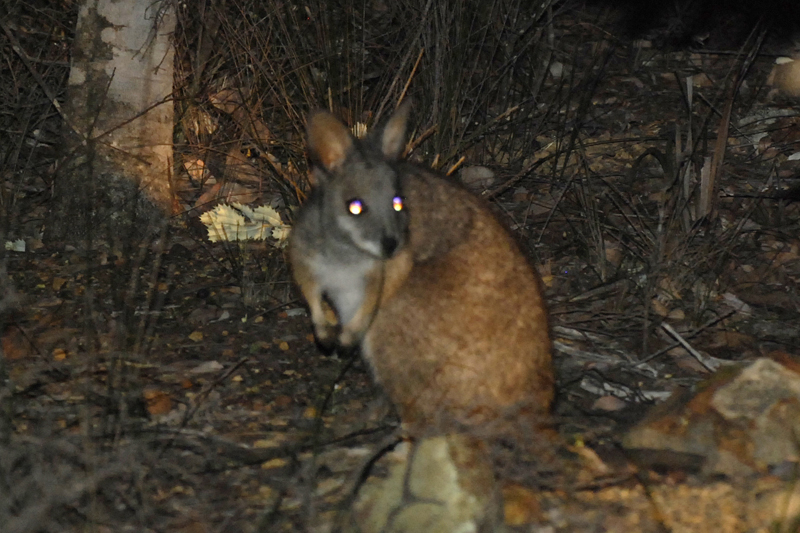
Many of these small mammals are nocturnal, and the two hour tour starts as night falls, and is led by a guide armed with a powerful spotlight. We saw five species of marsupial: western grey kangaroo, tammar wallaby, woylies, brush-tailed possums and bandicoots. The tammar wallabies are only a little larger than quokkas (up to about 60 cm):


The real speciality of Krakamia is the woylie:


The Krakamia population is by far and away the healthiest in Australia. Although they produce one offspring at a time, they can produce one every ten weeks in good conditions, and this means that many individuals can be released elsewhere. The worrying development is that, while the Krakamia population is still doing well, nearly all of the wild populations have crashed in the last few years. It seems that there may be two diseases involved, and all releases from Krakamia have stopped (there's no sign of disease there, and the released animals don't seem to be the source of the problem. This last photo of a mother woylie with a youngster at foot is a terribly poignant reminder of just how near the brink many of these species are.